

Introduction
Microorganisms play a crucial role in the world of food, impacting its production, safety, and shelf life. Unfortunately, these tiny creatures can sometimes lead to food that’s unsafe for us to eat. This is because certain microorganisms, which are often the culprits behind food spoilage, can also be harmful and cause foodborne illnesses. These illnesses pose risks not only to those who consume the contaminated food but also to the people involved in its preparation and society as a whole(1,2).
The list of common foodborne troublemakers includes bacteria like Clostridium botulinum, Campylobacter, various strains of Escherichia coli, Salmonella, Shigella, Staphylococcus aureus, as well as fungi such as Penicillium and Aspergillus. Viruses like Hepatitis A, Rotavirus, and Adenovirus can also be responsible for foodborne illnesses (3).
To combat these threats, methods for detecting these pathogens have been developed to ensure that food meets the necessary safety standards, which are often based on either the presence or absence and the quantity of these harmful microorganisms (4).
In recent years, there has been a growing demand for quicker, more dependable ways to find harmful germs in our food. Machine learning (ML) is like the brain behind these methods. It has improved how we create sensors to spot these germs. ML can understand complex patterns that are hard for regular methods, which helps us detect germs better. This reduces the chances of making mistakes by saying germs are there when they aren’t or missing them when they are. ML also helps us make sense of lots of sensor data and figure out patterns related to different harmful germs. One cool example of this is using fiber-optic Raman sensors. Optical fiber Raman spectroscopy is a powerful scientific technique that utilizes laser light to analyze the composition and properties of various materials, such as liquids, gases, and solids. It relies on the interaction of light with molecules in a sample to provide valuable insights into the sample’s molecular structure, chemical composition, and other characteristics (fig.1)
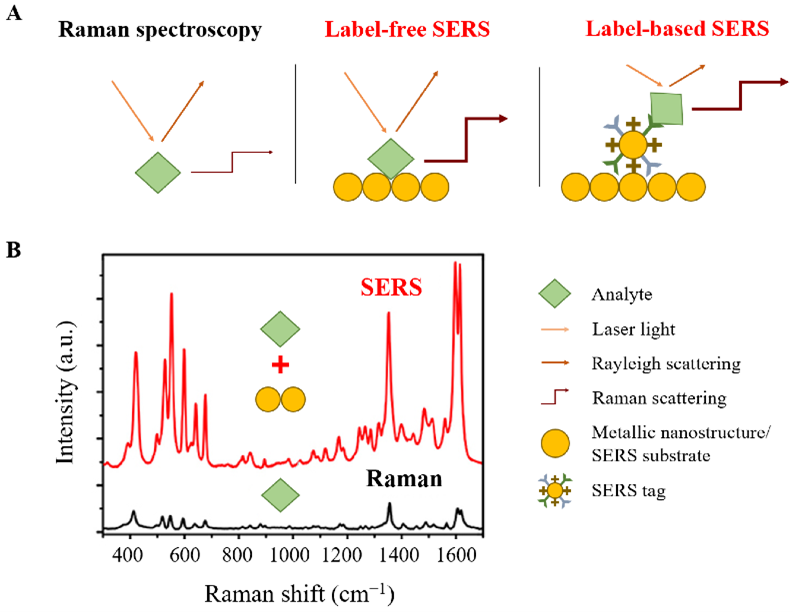
This technique starts with a laser light source emitting monochromatic light, typically in the visible or near-infrared range. The laser light is directed onto the sample, causing some photons to scatter inelastically. This Raman scattering contains information about the vibrational and rotational energy levels of the molecules, allowing for the identification of specific molecular bonds and chemical composition. the use of optical fibers in Raman spectroscopy enables remote and real-time sample analysis (fig.2).
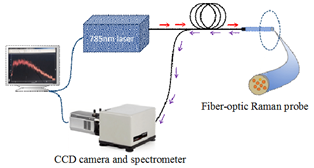
Fiber-optic Raman sensors use thin, flexible, and highly transparent optical fibers to transmit and collect scattered light, expanding the possibilities for a wide range of applications. We combine these sensors with selected ML models to detect harmful germs in real-time. We trained six ML models to quickly identify these germs by looking at special smelly compounds in the food called volatile organic compounds (VOCs). To make sure our method works, we used eight common VOCs that come from spoiled food and can make people very sick. We mixed these VOCs in different amounts to mimic what can happen in real life. Then, we used our sensor and the ML models to check these mixtures, and the results were really good at finding even tiny amounts of harmful germs (5). This is important for keeping our food safe and preventing sickness. These results demonstrate the potential of the developed approach for rapid and accurate detection of foodborne pathogens, which can be critical for ensuring food safety and preventing foodborne illnesses. Fiber-optic Raman sensors stand out for their quick response, durability, and non-destructive detection capabilities. As a result, they have the potential to revolutionize food safety by enhancing our ability to detect these harmful microorganisms and keep our food supply safe (6).
This approach would be extremely useful in the earlier detection, and management of foodborne outbreaks thereby enhancing public safety and health. Current and future directions should be focused on ensuring that existing tools are applied for foodborne pathogen control through training of food surveillance and safety officers on the use of these methods. In addition, more research should be carried out on the development of more effective approaches (such as the use of bacteriophages for the control and elimination of foodborne pathogens.
1. Iulietto MF, Sechi P, Borgogni E, Cenci-Goga BT. Meat spoilage: A critical review of a neglected alteration due to ropy slime producing bacteria. Ital J Anim Sci. 2015;14(3):316–26.
2. Saucier L. Microbial spoilage, quality and safety within the context of meat sustainability. Meat Sci [Internet]. 2016;120:78–84. Available from: http://dx.doi.org/10.1016/j.meatsci.2016.04.027
3. Bintsis T. Foodborne pathogens. AIMS Microbiol. 2017;3(3):529–63.
4. Elbehiry A, Abalkhail A, Marzouk E, Elmanssury AE, Almuzaini AM, Alfheeaid H, et al. An Overview of the Public Health Challenges in Diagnosing and Controlling Human Foodborne Pathogens. Vaccines. 2023;11(4):1–34.
5. Zhang B, Asad Rahman M, Liu J, Huang J, Yang Q. Real-time detection and analysis of foodborne pathogens via machine learning based fiber-optic Raman sensor. Measurement. 2023 Aug 1;217:113121.
6. Petersen M, Yu Z, Lu X. Application of Raman spectroscopic methods in food safety: A review. Biosensors. 2021;11(6):1–22.